








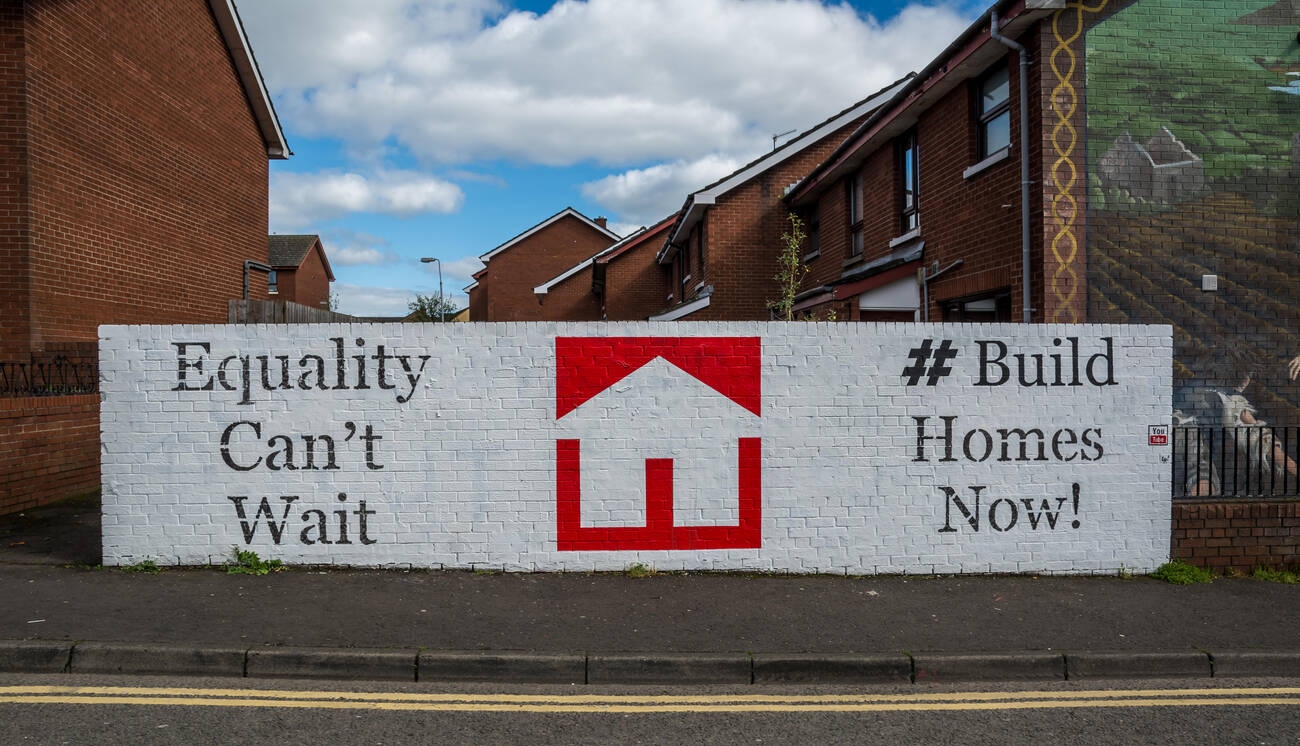
The Northern Ireland housing crisis is currently one of the most serious in history; Stormont politicians continue to ignore it. Politicians at Stormont continue to offer little more than promises while thousands wait for homes that may never be built. The root cause of this disaster is not high demand but zero supply. Politicians have preferred to rely on lobbying and election promises rather than real investment in sewage infrastructure and housing. Stormont must take action now, not offer more promises or pass legislation.
The Escalating Northern Ireland Housing Crisis
Northern Ireland’s housing crisis continues to face severe pressures. From the start of COVID-19 through to the end of 2025, average house prices surged by 45 percent. The average increase in the UK is 18 percent, with some local areas experiencing growth of up to 51 percent. In Belfast, prices rose by 10 percent in one year; Rents have increased by 50 percent over the past five years. Many tenants now spend one-third of their income on housing costs.
These challenges are not limited to prices. Supply has collapsed dramatically. Latest government statistics show 30% drop between Q4 2024 and 2025. The Chartered Institute of Housing (CIH) Northern Ireland has raised concerns over the drop in new home starts for the period from October to December 2025.
According to the Department of Finance, 1,075 homes were started in Q4 2025. This represents the lowest figure for new starts since 2013 and a 30% drop from Q4 in 2024.
Georgia Knapp, policy and public affairs manager at CIH Northern Ireland, said: “Alarm bells should be sounding for everyone in the housing sector as we look at the lowest number of new homes starts since a post-recessionary period in 2013. Unfortunately, this downward trend may be a sign of things to come if action isn’t taken quickly.”
Supply Shortages and Infrastructure Barriers Fuel
The core issue lies in restricted supply rather than demand alone. Housebuilding in the region has fallen to historically low levels. Build Homes NI, the representative body for Northern Ireland’s largest housebuilders, has raised concerns that the development of over 15,000 homes in the region is being impeded by a lack of capacity in its sewage system.
The worst-affected council areas are Mid Ulster (2,337), Belfast (1,933), and Derry City and Strabane (1,775). Minister for Infrastructure Liz Kimmins confirmed the impact on house building when she answered a question in the Northern Ireland Assembly this month. This confirmation comes as the Northern Ireland housing crisis has reached unprecedented levels of homelessness.
There are now almost 50,000 applicants on the region’s waiting list for social housing, including almost 14,000 in Belfast.
Housebuilders Sound the Alarm
Build Homes NI Director, Paul McErlean, said: “Wastewater is critical infrastructure, but years of underinvestment has left much of Northern Ireland’s sewage network at full capacity. No capacity means no new connections, and that means that new developments, be that housing or factories, could be refused planning permission.
NI Water has 68 wastewater treatment works with no capacity and a further 107 networks with restricted capacity. As a result, the lack of wastewater capacity is blocking the development of 15,386 homes in Northern Ireland and has driven housebuilding in the region to historically low levels.
It is terrible news for people trying to buy a house for the first time and helps explain why increases in rent and house prices in Northern Ireland are the fastest growing in the UK.”
Wastewater Infrastructure as the Primary Barrier
Aging wastewater infrastructure is a critical barrier to resolving the Northern Ireland housing crisis. Decades of underinvestment have left Northern Ireland’s wastewater infrastructure largely outdated and in urgent need of modernization.
It means there are more than 100 towns and villages where the system is operating near or above capacity and cannot accommodate any additional wastewater connections. Therefore, the problem of wastewater infrastructure is preventing house building.
The £3.5 Billion Funding Gap
NI Water estimates it needs £3.5bn to fund the development of the wastewater system. NI Water will soon submit a new business plan to the Utility Regulator. They have disclosed to UTV their assessment of the necessary funding for a five-year period beginning in 2028.
Dr Gary Curran, Director of Engineering, NI Water, said that “it’s in the order for this first five-year period of three and a half billion pounds of capital investment.” NI Water has previously warned that paying fines will reduce funding for development. They’re going to ask for £3.5 billion.
Political Inaction on the Real Blockage
Paul McErlean of Build Homes NI said: “That is what is required to build a modern sewage system that’ll supply the houses.” When asked whether he had any confidence that the funding would be secured, he responded: “Zero at the moment.”
Although portions of the wastewater network date back to the Victorian era, insufficient funding has prevented the system from fully entering the 21st century.
Build Homes NI, the house builders’ lobby group, criticised recent proposals, describing them as “a distraction from the fundamental problem, which is NI Water’s broken funding model.” Paul McErlean, director of Build Homes NI, said: “NI Water is facing a £2bn deficit during its next funding period, and as the Department for Infrastructure’s own consultation acknowledged, developer contributions will not address the magnitude of this funding crisis.”
Budget Responses and Political Inaction
Northern Ireland’s draft multi-year Budget must go further to address the housing crisis, Chartered Institute of Housing (CIH) says. CIH says the first multi-year Budget in over a decade fails to adequately address the Northern Ireland housing crisis. The Northern Ireland Executive has not agreed on a multi-year budget since the 2011 to 2015 period.
The draft Budget, which is out for consultation until early March, covers the period from 2026 to 2029-30. It proposes that capital spending for the Department for Communities will be just under £295m in 2026-27, rising to £404m in 2029-30.
Social housing is one of the areas recommended by the government for “earmarked allocations” of capital funding, totalling £441.7m over the four years.
Impacts on Residents and the Economy
The effects span generations. In the Northern Ireland housing crisis, renters face intense competition because supply remains tightly constrained. Young people and families now spend a growing share of their income on housing, which delays home ownership and adds to broader social strain.
The crisis spills into homelessness services, with temporary accommodation costs rising and waiting lists growing. CIH has warned that without immediate intervention, the situation risks becoming a catastrophe. The membership body is part of the Wastewater Infrastructure Group, which is a coalition of housing, construction, and business organizations.
It is calling for a low-cost infrastructure levy, which would be payable through the rates system. The levy would be averaging £1.25 per household per week or £65 per annum. Knapp added: “This levy would create a sustainable, multi-year investment model for NI Water, enabling stalled housing, industrial and regeneration projects to proceed.”
If the government does not seriously increase the infrastructure budget by the end of this year, the housing crisis will quickly turn into a social and economic crisis. There is no time for making promises. It is the time for the government to take action.